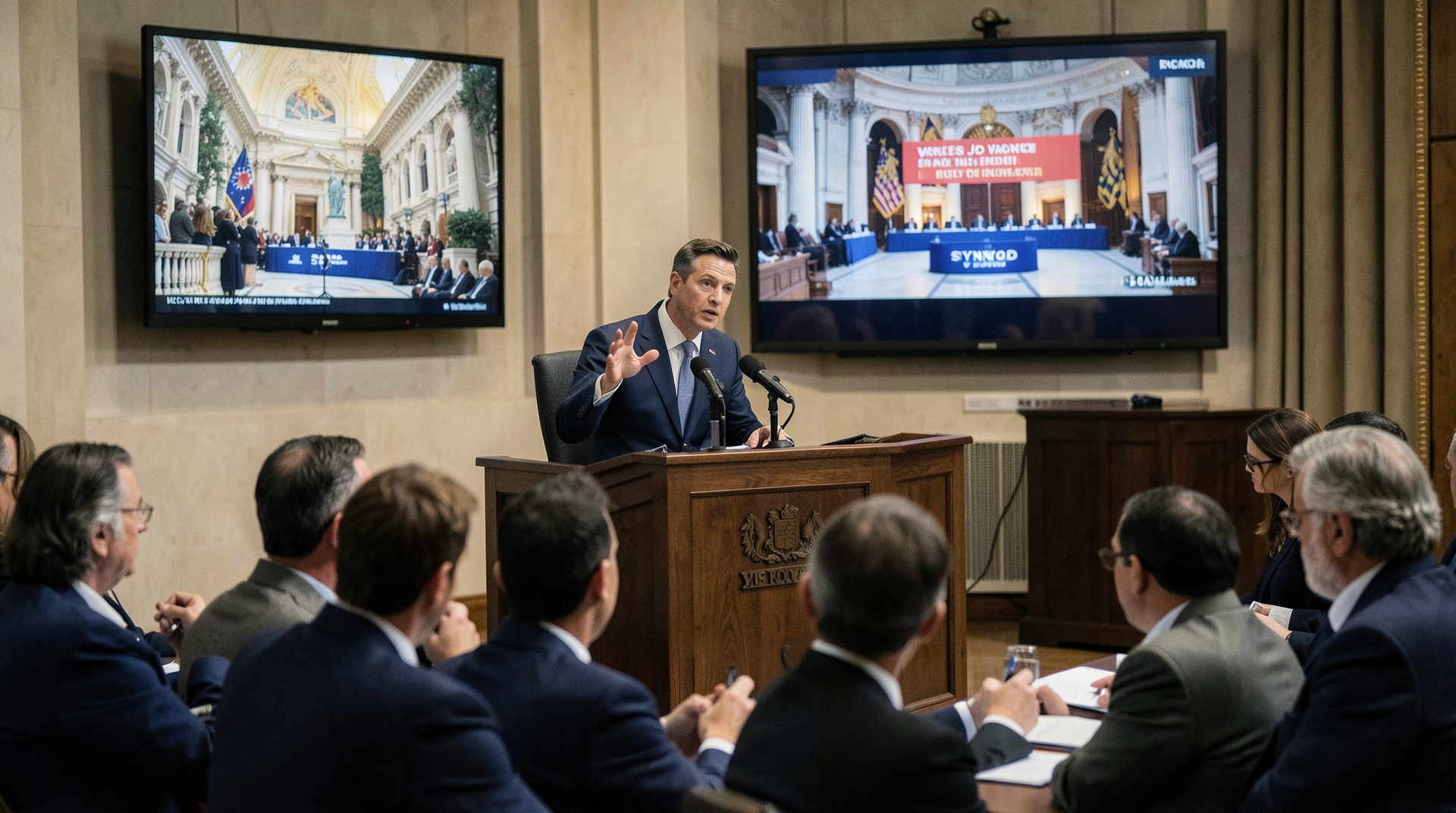
Vice President JD Vance — the first Catholic vice president since Joseph Biden — told White House reporters on Monday May 19 that Pope Leo XIV's encyclical Magnifica Humanitas "is going to have some influence" and that the Trump administration is "pro-innovation" on artificial intelligence. The remarks were delivered from the briefing-room podium in response to a question about the Pope's forthcoming guidance and were captured by Catholic-press reporters in the room; the verbatim transcript appears on The Dialog. [1] Five days before the encyclical drops Monday at 11:30 a.m. Rome time the highest-ranking Catholic in the executive branch has spoken on it in conciliatory rather than adversarial terms. Saturday's edition position — that "the Trump administration silence on the encyclical has held through Saturday" — is openly corrected. The administration spoke five days before publication, and the corner of the triangle that the paper marked silent has its first paragraph.
The paper's Saturday major on Magnifica Humanitas publishing Monday and the Vatican press kit still not being out framed the encyclical as a T-minus-two religion-tech-power compound; Saturday's standard on the Anthropic Magnifica silence on the thirty-billion weekend being the pattern carried the position that the lab had said nothing about the encyclical, the SpaceX-Anthropic $45 billion compute disclosure, or the $30 billion round closing past OpenAI's $852 billion valuation. The Sunday update is asymmetric. One corner of the compound — the Trump administration — has spoken. Three corners — the Vatican press kit, the Anthropic lab, the SpaceX disclosure follow-up — have not. The silence has been corrected on the side of the state. It has not been corrected on the side of the lab.
The Vance quote, in full, is shorter than its consequences. Asked by a reporter what influence the Pope's guidance on AI might have on "broader society," Vance said: "I think when the Pope issues an encyclical, it's going to have some influence" — and then, in the same answer, framed the administration's posture as "pro-innovation," noting that he had not yet seen the document. [1][2] The Dialog's account, verified by Catholic Vote's social posting that ran the same afternoon, places the question and answer inside a routine White House briefing on Monday May 19. [3] The remark is short. It is also the only on-the-record administration statement on Magnifica Humanitas before publication. The reading is the question. What does "some influence" mean from a Catholic vice president whose administration's federal-use block on Anthropic from February remains the Washington predicate underneath the encyclical?
There are three available readings, and they are not mutually exclusive.
The first reading is that "some influence" is Catholic-VP boilerplate — the kind of polite deference any Catholic in public office owes a sitting pope, particularly the first American pope, particularly when the pope is issuing his first encyclical. By this reading, Vance was not making news. He was acknowledging that the Pope was about to make news. The framing as "pro-innovation" is the substance: the administration's position on AI is "pro-innovation" and any encyclical, however much "influence" it has, will not shift the administration's regulatory posture. The encyclical, in this reading, is a religious document that lives in the moral discourse and not in the regulatory file. The federal-use block on Anthropic stands; the State Department's Article 6 EU-engagement track stands; the Cerebras-OpenAI-Anthropic compute economy stands. Vance has discharged a courtesy.
The second reading is that "some influence" is a pre-position. The administration knows the encyclical is coming. It knows the document will be a doctrinal frame against AI labor automation and concentrated AI power, because Chris Olah's panel slot on the Vatican press dais Monday says so — Anthropic's interpretability lead would not be on the dais if the document were a pure-condemnation text. The administration also knows that a Catholic VP saying nothing about the encyclical would be read by Catholic-press observers as snub, and that a Catholic VP saying anything substantive would be read by Vatican-press observers as either deference or distance. "Some influence" is the middle: the encyclical will have influence, the administration is pro-innovation, the two are not in conflict yet, and the conflict — if there is one — is the encyclical's text to set, not the vice president's to anticipate. The reading is that Vance is reserving operational space for the administration to engage Monday's text on its own terms without having committed to anything in advance.
The third reading is that "some influence" is the administration speaking instead of the lab. Anthropic has said nothing. SpaceX's S-1 disclosure of the $45 billion Anthropic compute commitment was filed Friday and the company has produced no follow-up statement. The $30 billion round closed past OpenAI's valuation without an Anthropic communications-team paragraph on its connection to the encyclical week. The encyclical will publish Monday. In the absence of a lab statement, the administration's pre-position becomes the de facto industry-side document — Vance's "pro-innovation" framing reads, against the lab's silence, as the position the lab has not produced for itself. The reading is the encyclical lands in a Washington atmosphere where the Catholic vice president has already accepted the encyclical's coming influence and where the leading domestic frontier lab has chosen not to say anything about being on the Vatican panel.
The Anthropic silence on Magnifica T-minus-1 is therefore the position holding. The lab has produced no statement on the encyclical, on Olah's panel slot, on the SpaceX $45 billion compute disclosure, or on the round closing through Saturday and into Sunday. The silence is operational. It is not a delay; it is a posture. The pattern in the religion-tech-power memo — that every other actor in the compound has produced a document while the lab has produced none — holds at T-minus-1. The administration's corner has been corrected by Vance's May 19 remark. The Vatican press kit corner remains in its Saturday status: a kit listing Olah on the speakers' dais without a transcript embargo and without a Sunday-evening preview text. The SpaceX corner remains the disclosure itself: a Friday S-1 line confirming Anthropic as the $45 billion customer locked in at $1.25 billion per month through May 2029, with no Anthropic-side acknowledgment. The lab silence is the corner the encyclical will have to find words for Monday.
What Olah will say from the dais Monday is the procedural question Sunday cannot answer. He is named in the Vatican press release; he is an Anthropic interpretability lead, not a corporate communications officer; he has been working on the kinds of mechanistic questions about model internals the Vatican press kit indicates the encyclical will address. The question is whether his Monday remarks are framed as personal — his own academic-style reading of the encyclical's themes — or as institutional. The institutional reading would be the first Anthropic-side document of the encyclical week. The personal reading would preserve the lab's silence pattern. The structural difference is which voice Anthropic chooses for Monday's panel: the lab, or the Christopher Olah who could be there as himself. Both readings are available; the press kit does not specify; the silence makes it ambiguous on purpose.
The Trump federal-use block on Anthropic from February remains the unaddressed Washington predicate. Vance's "pro-innovation" framing does not address it. The administration's stated posture on AI is "pro-innovation"; its actual policy on Anthropic specifically is exclusion from federal compute contracts. The two coexist in Washington's regulatory file the same way the Saturday-into-Sunday Iran-deal claim and the Lebanon-strikes operational tape coexist in the diplomatic file — surface and substrate, both real, both unreconciled. The encyclical Monday will arrive into that reconciliation gap. Whether the text names labs by name, or stays at the level of "artificial intelligence" as a category; whether it addresses the labor-displacement question, or stays at the level of human dignity; whether it cites specific commercial dependencies, or stays at the level of moral economy — these are Monday's questions. Vance's May 19 remark does not preempt them. It frames the room they will land in.
The Bessent Sunday talk-show schedule is the next administration-on-camera test of the Iran-deal claim and the second-order test of the encyclical posture. Treasury Secretary Scott Bessent's Sunday morning slate — Meet the Press, This Week, Face the Nation — will produce the next official commentary on the financial-side questions the encyclical and the Anthropic round both raise. Whether Bessent addresses the federal-use block, the Anthropic round, or the encyclical at all is the question Sunday afternoon's transcripts will answer. The institutional silence on the lab side is now the answer Bessent's interviewers will ask about, with Vance's May 19 remark as the floor of what the administration has already conceded.
The correction the paper runs Sunday is therefore narrow and specific. The Saturday position that "the Trump administration silence on the encyclical has held through Saturday" was wrong; Vance spoke May 19. The lab-side silence position, which Saturday also carried, still holds. The contradiction the paper now reads is between the state speaking and the lab not — the inverse of what the past week's silence pattern made it look like. The state has used its words. The lab has not. Monday's encyclical text will arrive into a room where the Catholic vice president has been heard from and the lab whose interpretability lead is on the Vatican panel has not. That is the position holding into Sunday afternoon, and the position the next twenty-four hours will either preserve or reshape.
-- ANNA WEBER, Berlin