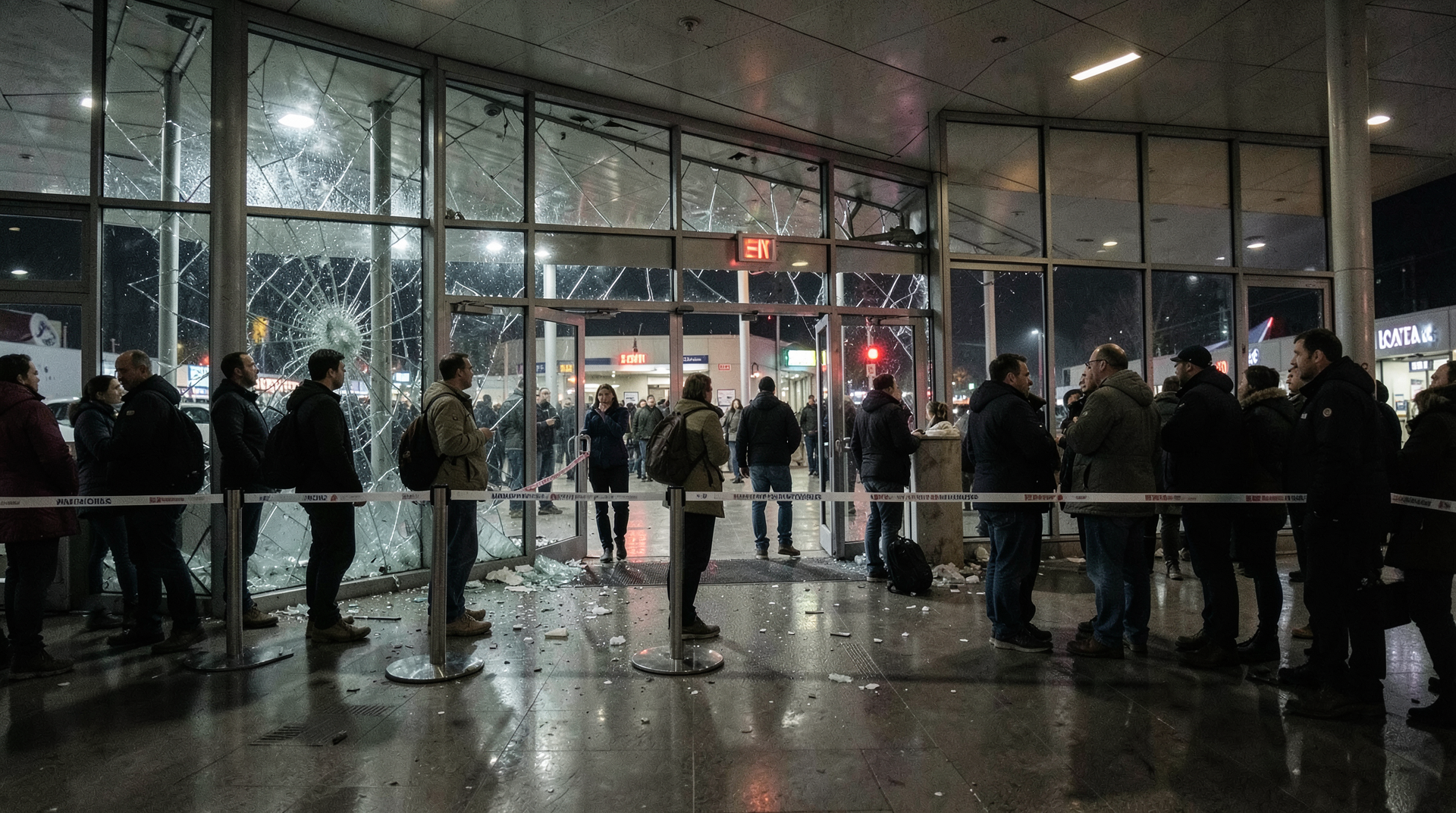
Kuwait International Airport has moved the Iran war from communique language to terminal glass.
The BBC reported that Iranian drone strikes on Kuwait International Airport killed one person and injured more than 60, with Iran denying responsibility, U.S. officials attributing the attack to Iran, and Kuwait expelling Iranian diplomats. The same file reported that the dead person was an Indian citizen. [1] The facts are not merely regional color. They give the war-powers debate a civilian terminal, a casualty count, a denial, an attribution, and a diplomatic consequence.
That is why the paper's June 1 account of Trump sending back Iran text as strikes widened the record now reads less like a diplomatic sequence than an operating map. The same edition's war-powers article argued that Kuwait and U.S. strikes made authorization more than floor-speech abstraction. The airport strike makes that claim visible to anyone who has stood in a departures hall.
The mainstream frame is escalation. It should be. A civilian airport in a Gulf state is not an outlying base. It is a public node: families, migrant workers, business travelers, security guards, airline crews, and the people who clean the floor after the camera leaves. BBC Verify has also named a wider damage ledger of U.S. military sites, including Kuwaiti sites, that keeps the airport from being treated as an isolated flash. [2]
The X frame is evidence. The memo's verified X post from Arab Times Kuwait offered video language around the terminal strike. That does not settle attribution. It does change the burden of coverage. Once readers can see terminal damage, official language about regional risk stops being atmospheric.
The useful middle is the record. The airport strike does not by itself prove a legal theory, a command chain, or a congressional obligation. It does prove that the Iran conflict now has a civilian-infrastructure file in Kuwait. BBC's report ties the incident to casualty numbers, denial, attribution, expulsions, and Secretary of State Marco Rubio's testimony. [1] Those are the elements Congress should be forced to hold in one frame: who was struck, who is blamed, what evidence exists, what the United States says, and what authority is being claimed.
Iran's denial matters because denials are part of the record, not because they end it. Kuwait's expulsions matter for the same reason. A state does not expel diplomats as a weather report. It signals that the incident crossed a political threshold. [1] If the attribution later changes, the expulsion becomes evidence of the first official judgment. If the attribution hardens, the expulsion becomes the opening move of a broader Gulf file.
The Indian citizen killed in the strike keeps the story from collapsing into an abstract Gulf escalation. [1] Kuwait's airport is a labor and transit space as well as a sovereign target. The war's perimeter is not defined only by flags on military maps. It is defined by who is standing under the roof when the drone arrives.
That is the part a war-powers debate tends to miss when it becomes a contest over party loyalty. The legal question is not only whether U.S. forces fired, were fired upon, or supported allied operations. It is whether the conflict system in which the United States is acting has widened to include civilian infrastructure in a country hosting U.S. and allied activity. BBC Verify's broader U.S.-site damage ledger supplies the companion evidence: the military and civilian records are now adjacent. [2]
The policy question is narrower and harder. Does Kuwait publish a full casualty and damage assessment? Does CENTCOM or the Pentagon release a timeline? Does Iran offer evidence for its denial? Does Congress ask whether the airport strike belongs in the same authorization record as U.S. strikes, returned Iran text, Hormuz threats, and Lebanon conditions?
The paper should not call the airport strike a casus belli without the records. It should not call it a media panic either. A passenger terminal has entered the war file. That is enough to demand a better ledger than slogans.
-- YOSEF STERN, Jerusalem