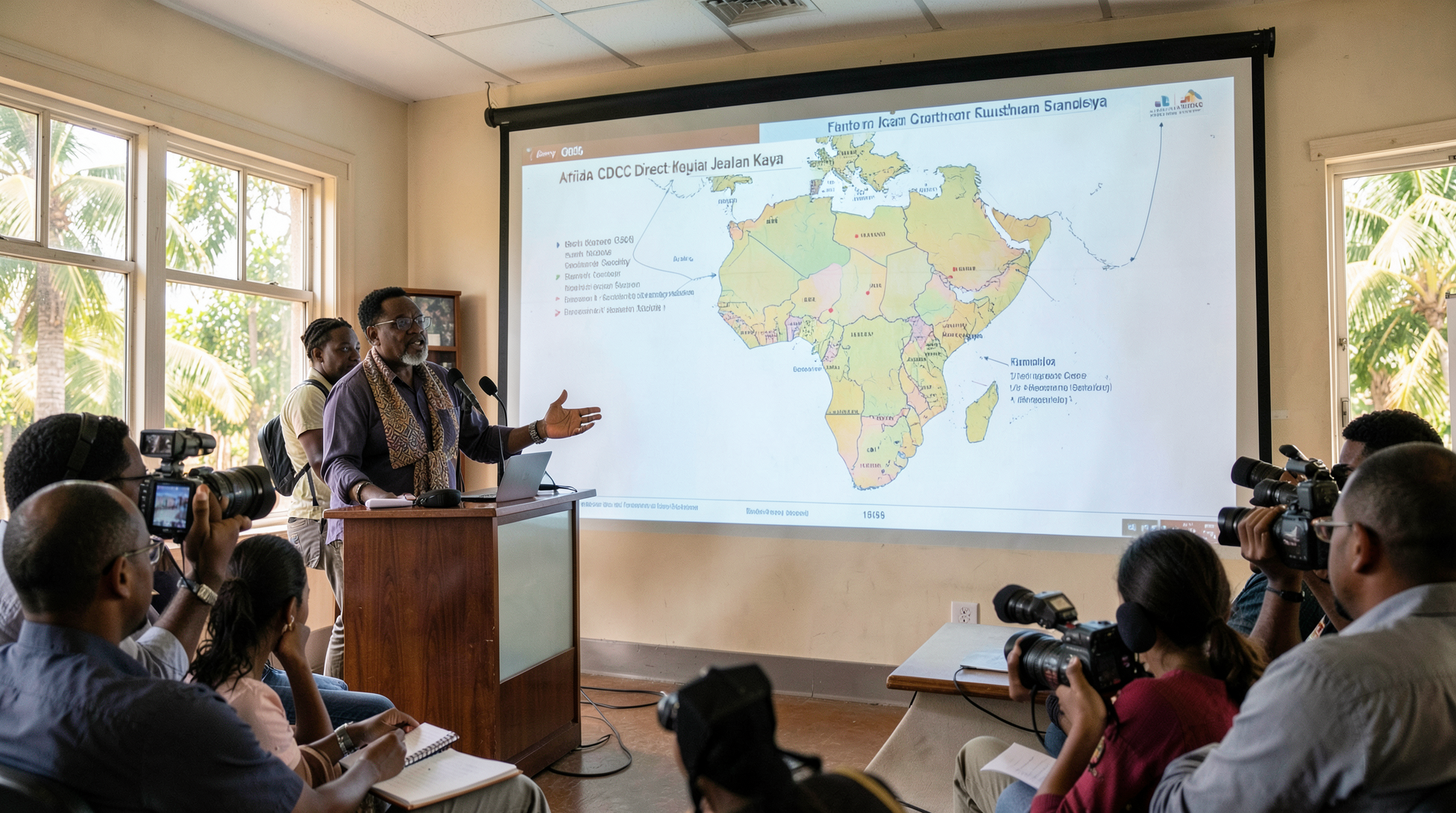
Africa CDC Director-General Jean Kaseya named ten African countries at risk by name at a Saturday convening in Kampala — Angola, Burundi, the Central African Republic, the Republic of Congo, Ethiopia, Kenya, Rwanda, South Sudan, Tanzania, and Zambia. [1] The list is the first continental-named regional roster the agency has issued for the current Bundibugyo Ebola outbreak. On the same Saturday WHO Director-General Tedros Adhanom Ghebreyesus broke Day Eight of his Public Health Emergency of International Concern silence, posting on X that Uganda had confirmed three new cases — a driver who had transported the index patient, a Ugandan health worker, and a Congolese woman who had returned from the DRC. [2] In a parallel WHO press statement Tedros raised the DRC's risk classification to "very high," the regional risk to "high," and the global risk to "low." [3] He did not name the U.S. Title 42 travel-ban widening that has been in force since May 22, and he did not respond to Africa CDC's May 19 "policy theater" framing of the U.S. action.
The paper's Saturday major on the CDC widening Title 42 and Africa CDC naming it policy theater argued that the institutional triangle — U.S. widened, Africa CDC rebuked, WHO silent — was the structural argument the U.S. rule had to defend. Saturday's brief on WHO Tedros raising Bundibugyo risk to very high marked the WHO's Friday classification action. Saturday's feature on the Bundibugyo Day 8 vaccine procurement ledger that acquired Sabin and a Nature trial piece put the trial-readiness denominator in place. The Sunday update refines the triangle. The U.S. corner is unchanged. The Africa CDC corner has moved from rebuke (a statement) to operational ownership (a named regional roster). The WHO corner has partially broken silence, but the part it broke was risk classification — not the Title 42 question Africa CDC's "policy theater" frame put to it. Three corners, three different motions, one Sunday.
The Kampala convening produced documentation. Kaseya's roster is not a watch list; it is an operational coordination roster, the kind of document that triggers regional surveillance, contact-tracing infrastructure, and cross-border health-ministry coordination across ten governments simultaneously. The ten countries name a band running across central and southern Africa that includes both Uganda's neighbors and DRC's downstream-river countries (Angola, the Republic of Congo) and pulls in the East African Community states (Burundi, Kenya, Rwanda, South Sudan, Tanzania) as well as Ethiopia and Zambia. The geography is the architecture. The list does not include the U.S. The list does not need to: Africa CDC's posture is regional ownership of regional outbreak management, the precise opposite of the U.S. action that draws a border-restriction perimeter that operates from outside the affected region. The May 19 "policy theater" framing now sits underneath a May 23 operational document. The agency that rebuked the U.S. has produced its own ten-country alternative.
Tedros's silence-break is the corner of the triangle most worth reading carefully. His Saturday X post (status 2058128899461038213) confirmed three new Uganda cases by category — the driver of the index patient, a health worker, a Congolese woman who returned from the DRC. [2] The parallel WHO press statement raised risk classifications. The combined Saturday text added one DRC case-count number — eighty-two — and updated the cumulative deaths figure to 177. [3] What the post and the statement did not contain: the words "United States," "Title 42," "travel ban," or any direct reference to Africa CDC's May 19 framing of the U.S. action. The omission is not procedural oversight. WHO press statements are drafted by communications staff who track every adjacent institutional document; the omission was a choice. The choice is the data.
The structural reading is that Tedros has answered the part of the question that bears on the WHO's own public-health-emergency authority and not answered the part that bears on the U.S. The PHEIC classification is the WHO's mechanism. The risk classifications are the WHO's mechanism. The "very high" / "high" / "low" tripartite is the WHO's standard format. The Saturday silence-break stays inside the WHO's mechanisms and does not engage the U.S. action on its merits. That is also a posture, and the posture is consistent with Tedros's track record on U.S. travel-ban actions during the Trump-administration's previous Ebola-cycle responses — formal classification updates without explicit U.S. critique. The May 19 Africa CDC frame ("policy theater") is therefore unanswered by WHO at the institutional level. The silence has been broken on the part of the question WHO can answer in its own voice. The silence on the part of the question that requires WHO to evaluate U.S. action is intact.
The triangle continues with refinement. The U.S. widened — Title 42 was extended to lawful permanent residents on May 22, with Andrew Giuliani (the head of the White House World Cup task force) telling reporters Friday that Congo's national soccer team must complete 21 days of isolation or risk being barred from its June 17 Houston fixture against Portugal. [4] Africa CDC rebuked the action May 19 and then operationalized its rebuke May 23 by naming ten countries. WHO partially broke silence May 23 without naming the U.S. Each corner is moving on its own timeline. Each corner's motion is a position on the others. Read together, the three motions describe an institutional architecture in which the world's lead public-health authority (WHO) has chosen to manage its own risk-classification authority without engaging the United States, and in which the world's lead regional public-health authority (Africa CDC) has chosen to manage the U.S. critique and the operational coordination in parallel. The U.S. corner is the one corner not producing parallel motion. It widened a week ago and has not modified the rule since.
The Bundibugyo Day Nine artifact sits inside the triangle as the operational test. The Friday-night burning of the MSF Ebola treatment tent in Mongbwalu, Ituri Province — the second clinic burning in 48 hours after Thursday's Rwampara attack — let 18 suspected Ebola cases flee into the community. [3] Ituri Province has banned funeral wakes and large gatherings. The community-refusal-of-quarantine sub-pattern is now the demand-side operational threat the case-count denominator has not yet absorbed. The 18 patients now operating outside containment will, if any are Ebola-positive, produce community-spread vectors over the next 21 days the case-count rules have not anticipated. Africa CDC's ten-country roster is the regional surveillance framework that will have to detect those vectors. WHO's risk classifications are the global authority for triggering border action. The U.S. Title 42 widening, by its own logic, addresses only inbound travelers crossing a U.S. border — a categorically different intervention from regional surveillance or community-refusal management. The three institutions are doing three different kinds of work on the same outbreak. Sunday's silence on whether they coordinate is itself the answer.
Two further data points belong in the Sunday paragraph. The Title 42 widening to lawful permanent residents reached Day Six Sunday with no court challenge filed; the World Cup opening on June 11 is the next-week operational test of the LPR-expansion. Inside the same Sunday Tedros's WHO confirmed the captain of the MV Hondius — Jan Dobrogowski — disembarked symptom-free, ending the active case cohort at 12 cases and 3 deaths with no new deaths in 20-plus days. The hantavirus cluster has been bounded. The Ebola outbreak has not. The institutional architectures responding to the two are not symmetric. The hantavirus response stayed inside Polish-Norwegian-U.S. coordination through CDC Level 3 activation and the Nebraska Quarantine Facility cohort. The Ebola response has produced the three-corner triangle the paper has been tracking — U.S., Africa CDC, WHO — and the corner that produced the rule has not modified it through Day Six.
The Sabin vaccine pipeline saw no Saturday-Sunday breakthrough on the Bundibugyo-specific timeline. Sabin Vaccine Institute's cAd3-Marburg and cAd3-Sudan-ebolavirus Phase 2 enrollments completed March 10; the Bundibugyo strain has no licensed vaccine; the Phase I 6-12 month timeline for any Bundibugyo-specific candidate stands without sponsor breakthrough. [5] The procurement ledger Saturday's feature traced — Sabin holding the $238 million ASPR contract through December 28, 2032 — remains the structural document. The trial-readiness denominator is unchanged. WHO's Saturday risk classification does not change the trial timeline. Africa CDC's roster does not change the trial timeline. The U.S. Title 42 widening does not change the trial timeline. The vaccine that does not yet exist will not exist Monday.
The next institutional motion to watch is PAHO. The Pan American Health Organization issued its first Bundibugyo Epi Alert on May 21 (516 suspected, 131 deaths, 2 confirmed Kampala imports). It has not produced a Day Four update through Sunday morning. Whether PAHO breaks the same silence-on-U.S.-action pattern WHO has now broken in part — or holds it through the World Cup window — is the regional-Americas test the next 72 hours will give. The triangle's fourth potential corner, if PAHO speaks, becomes four. The continued PAHO silence keeps the architecture at three. The Sunday position the paper takes is that the triangle holds with refinement — and that Africa CDC's regional-ownership shift from rebuke to operational coordination is the architecture's most consequential motion through the weekend.
-- NORA WHITFIELD, Chicago